

The Promiscuity Myth
Why the rooster carousel isn't real, and why it persists in the popular imagination


We’ve been receiving mixed messages lately: on one hand, we’re in the midst of a sex recession, with young people retreating into digital monasticism as secular monks and nuns; on the other, we’re in the midst of a carnal carnival of fleshy carousel rides.
Those who orbit the manosphere believe both are occurring simultaneously (minus the nuns); promiscuity is out of control today, but women are Chadsexual—just as horny as men, if not more so, but only for Chad.

This drives them to spend their youth messing around with Chads during what’s referred to as their hoe phase. After they’ve had their fun and hit the wall, they suddenly begin showing interest in men they previously wouldn’t have given the time of day. Not out of any genuine attraction, of course, but because they realise their sexual marketplace value is rapidly declining and they’ve failed to lock down Chad, so they instead look to settle down with a schmuck who will serve as a dependable beta provider.
To be fair, if you insist on the notion that ‘hook-up culture’ is in full swing yet this isn’t most men’s experience, what other conclusion are people to draw from this? It’s a notion that invites conspiratorial thinking to fill in the gaps.
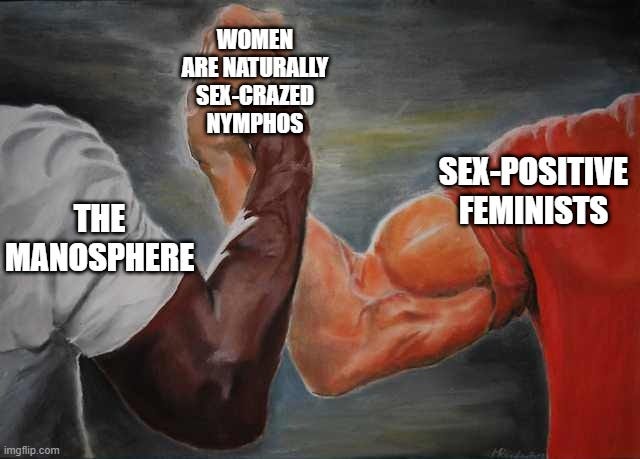
Feminists of the sex-positive variety have long endorsed a similar view under the banner of female empowerment: women are at least as sexually driven as men—if not more so, according to feminist cultural critic Wednesday Martin. The only reason we’ve believed otherwise, the argument goes, is because patriarchal double standards and outdated Victorian norms have long suppressed women’s true desires. Even some evolutionary psychologists seem to endorse this view—seemingly under the mistaken impression that this conflicts with manosphere thought.
It’s not uncommon to see in response to those who challenge this sex-positive framing a dunk like: ‘just because women don’t want to sleep with you doesn’t mean they don’t like casual sex!’—almost reinforcing the Chadsexuality charge.
I’ve already addressed the Chadopoly myth in some detail;1 let’s now take a closer look at promiscuity more broadly.
The promiscuity myth
The Youth Risk Behavior Survey shows that in addition to declining rates of sexual activity among high school students, the share reporting sex with four or more partners over their lifetime has declined across both sexes.

What constitutes ‘promiscuity’ is of course subjective. To those of a more traditional persuasion, any premarital sex might suffice. For most people though, it’d probably take at least four partners in the span of a year—a number unlikely to result purely from serial monogamy unless it’s an unusually unstable person.
We also see no rise in the share of men or women aged 21–30 reporting four or more sex partners in the past year in Monitoring the Future; this remains confined to about 10% of young adults, with the percentage for men apparently having fallen slightly.

I also looked at the General Social Survey data and found a similar pattern; while the proportion of men reporting high partner counts declined over time, for women it stayed quite stable, producing what looks like a convergence. Personally, I think this may simply reflect more accurate reporting. The mean partner counts reported by men and women are typically incompatible, suggesting misreporting. If overall promiscuity is declining but women are reporting more candidly, the effects may cancel each other out. It’s also possible that promiscuity has remained stable but men are less prone to exaggerating. Since sexual inactivity trends seem to apply to both genders equally however, I’d say the former is more likely.
A 2023 Dutch survey found that 15% of men and 14% of women aged 18–24 had sex with more than one partner in the past six months, and 8% of men and 9% of women in this age bracket had more than 10 lifetime partners. These figures were basically unchanged since 2017.

It remains the case that most young adults’ sexual acts occur within relationships rather than one-night stands or FWBs.

A 2017 Swiss survey asked specifically about casual sex. 75% of men and 71% of women aged ~26 reported ever having engaged in it, and the median number of casual sex partners over their lifetimes was 2–3. 14.4% of men and 9.4% of women reported more than 10, meaning that since becoming sexually active, 85-90% would have fewer than one partner per year.
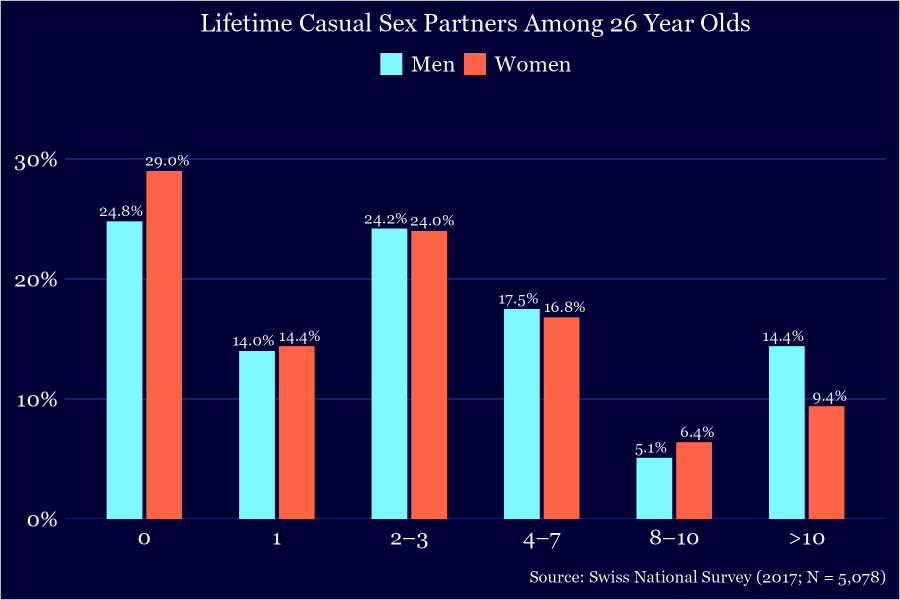
Among those with casual sex experience, 73% of men and 76% of women had none in the past month; 19% and 20% had one; and 8% and 4% had more than one.2

South & Lei (2021) documented a decline in casual sex between 2007 and 2017; by 2017, 24% of unpartnered men and 22% of unpartnered women reported having had sexual intercourse in the past month, down from 38% and 31%, respectively. Among men, a significant portion of this decline was attributed to reduced alcohol consumption, increased time spent gaming, and higher rates of parental coresidence.
A popular notion is that dating apps have driven up promiscuity, but higher partner counts among dating app users have been found to be mediated by user characteristics, and even when it comes to one-night stands, only about 20% originate through dating apps; a larger share do in social venues like bars, parties, and festivals, where there tends to be alcohol involved.
Those invested in the promiscuity narrative often selectively reject self-reported sexual behaviour data; in this case by claiming that women are underreporting their body counts. However, self-reported sexual partner data, while not perfect, seems to be quite reliable—especially when it comes to more recent partners such as those encountered within the past year. Moreover, if one maintains that female promiscuity has risen in recent years, one must also accept the arguably counterintuitive premise that women have simultaneously become more reluctant to admit it to cancel out the effect—and since it’s rarely suggested that men understate their body counts, the ceiling on how high female promiscuity could be isn’t that high regardless.
The DTF? experiments
The sexual revolution didn’t revolutionise biology; men remain cursed with a higher sex drive, think and fantasize about sex more often, and masturbate more frequently than women, as well as having more permissive attitudes towards casual sex. A recent study found no evidence that self-reported sexual motivation is meaningfully influenced by social desirability bias, either.
A classic study quite pointedly illustrated this by having participants cold approach opposite-sex students on campus who they found attractive and ask one of three things: to go on a date, come back to their apartment, or have sex that night. About half of both men’s and women’s date requests were accepted, but predictable differences emerged for the other requests: none of men’s sexual requests and virtually none of their apartment requests were accepted compared to about three fourths of women’s. Participant attractiveness didn’t appear to affect the outcome, possibly due to limited variation.
Roughly a decade later, in the midst of the AIDs epidemic, another study was conducted, with results largely in line with the original. In one experiment, participants made the same request to single friends, but on behalf of a third party they assured were warm, sincere, trustworthy, and attractive. Few declined the date offer, but the numbers for the sex request barely changed: 5% of women accepted, compared to 50% of men. Safety concerns therefore seem unlikely to explain the gender gap—reinforced by the fact that only two women in the first and none in the second experiment cited safety as their reason for rejecting the request.
A similar experiment was carried out in 2003 by a journalist who was apparently unaware of the earlier studies and was reportedly above average in attractiveness. He approached 100 women in German cities and asked them for sex. Six accepted, and the subsequent encounters were confirmed (by him at least). Five of the six successful approaches were made indoors, four of them in the evening or night. While he was in his late 20s, only one of the women was under 30; two were 38, and one was 50. I guess the takeaway is to go for cougars.
Did sexual openness converge as society continued to move in a sex-positive direction? Hald & Høgh-Olesen (2010) had Dutch students approach opposite-sex on a university campus or public spaces. The results largely mirrored those of the original studies. Only one out of 54 women accepted the sex request (2%), compared to 38% of men (59% for single men). Consent rates for were lower overall in this study: 30% for men and 20% for women accepted date requests, and 22% of men and 8% of women accepted apartment requests. A small effect of subject-rated attractiveness on male participants’ date requests being accepted was observed.

Another such study was conducted by Guéguen et al. (2011). Two men and two women were selected from a pool of 14 male and 11 female university students—one of average attractiveness and one rated the most attractive. Targets aged 18–25 were approached in a pedestrian zone in a French town. None of the mid guy’s sex offers were accepted, while the hot guy had a hit rate of one in thirty. His apartment requests were also accepted more than twice as often as the mid guy’s. Among the women, the already high success rates just became even higher for the hot one.

Baranowski & Hecht (2015) had German students approach opposite-sex individuals on a university campus or at student clubs. After each approach, participants rated the target’s attractiveness and vice versa. Those who were approached in the party condition reported how drunk they felt. In the party setting, subjects also reported how intoxicated they felt, while participants rated how drunk they thought the subjects were.
Yet again, just 1 of 52 women accepted the sex request. Contrary to expectations, only male subjects’ consent rates significantly rose in the party condition. Participant attractiveness and subject consent correlated relatively weakly at r = .29. Self-perceived intoxication correlated with consent at r = .2. Participants’ ratings of subjects also correlated with self-perceived intoxication at r = .43, and subjects’ ratings of participant attractiveness correlated with self-perceived intoxication at r = .21. So alcohol loosens people up and also makes them more generous in their looks judgments—but still not enough for more than one in twenty five women to accept a sexual offer.

Over 40 years following the original study, Kunz & Greitemeyer (2024) conducted another replication at an Austrian university. Little appears to have meaningfully changed.3

And then we have this tall dark and handsome pickup artist Paul Janka, who reportedly collected phone numbers from 3,428 women he approached in New York city. Of these, he managed to sleep with only 153, translating to a success rate under 5%—and this isn’t counting the approaches rejected at the outset.

And how could we forget Johnny Bravo who was brutally rejected every single time despite being an archetypal Chad.
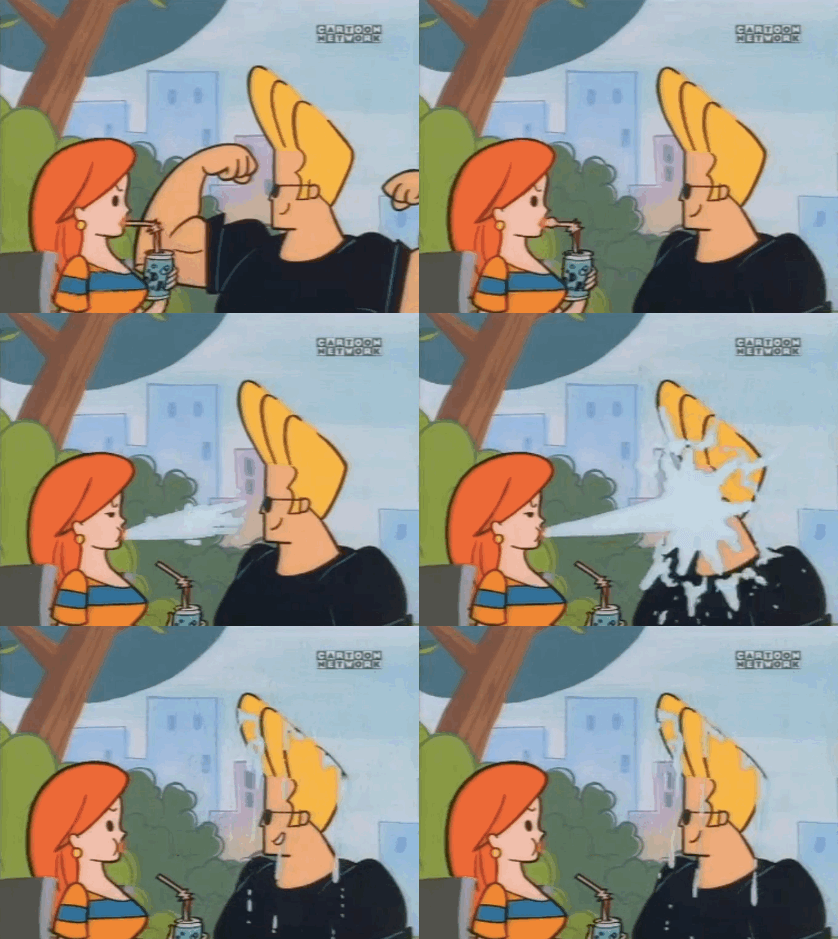
The fantasy of the mythical Chad Thundercock who simply walks up and drops a woman’s panties with a grunt is just that. In Guéguen et al., the most attractive man was selected from a group of fourteen, which—assuming the sample wasn’t unusually ugly or clustered in the middle—would put him somewhere in the top 10% of attractiveness. He got 1 out of 30 women (3%) to agree to sleep with him, and even that could’ve been a fluke. How much higher would it realistically be if he were in the top 1% or even 0.1%? Unless you’re famous, there’s likely no attractiveness level that enables effortless sexual conquest. Maybe if a top 1%er scraped the bottom of the barrel they could score with decent regularity and without too much time investment, but at that point he’d probably prefer to just pair off with a woman around his own attractiveness level.
Of course just going up to a woman and asking bluntly if she’s dtf is a borderline autistic approach. It’s worth considering that the apartment requests had higher success rates—this allows for plausible deniability and room to set the mood before making a move, and are probably a more common route to casual sex than the more overt proposals.
The orgasm gap
A key reason women display less enthusiasm for hooking up is that the reward of orgasm is seldom delivered. Armstrong et al. (2012) found that women whose most recent sexual encounter occurred within a relational context were markedly more likely to climax and report high sexual enjoyment than those whose encounter was a hook-up. The likelihood of orgasm also rose with repeated hook-ups with the same partner—though this may reflect a selection effect, whereby men more proficient in eliciting it were more often revisited. Sexual practices conducive to female orgasm were also more commonly performed in relationships.

Piemonte et al. (2019) found that across three studies, men orgasmed in about 82% of casual sex encounters, whereas women did so in only 32%. Notably, women’s less positive responses to these encounters were found to be fully accounted for by this gap.
One explanation for the purpose of the female orgasm is its role in facilitating pairbonding, through oxytocin release that fosters trust and attachment. Long-term partners will also naturally become better attuned to and more inclined to satisfy one other.
This pattern is slightly awkward for the alpha fux, beta bux meme—or alternatively for women, if we accept the meme as true—as it suggests that the beta males that women pair with are if anything more capable of arousing and inducing orgasms than the alpha Chads they supposedly chase for casual sex.
All of this helps explain why women aren’t typically dtf with strangers. When hook-ups rarely deliver much pleasure but bring potential risks, there’s little appeal in becoming town bicycles unless weird or dealing with severe self-esteem issues. Even then, you’d think the awareness of being desired for casual sex would suffice without needing to go through with the act.
Assortative sluttery

In the meme outlined earlier, the typical woman—after a life of unrestrained debauchery and a body count in the 50–100 range—suddenly decides to settle down with a relatively inexperienced betabux to leech from in exchange for passionless, monthly starfish sex. The same people who promote this meme recognise that women are now less dependent on male provisioning—yet according to the memebrained cuckpost below they apparently still choose to reproduce with these repulsive and obsolete beta males?

In reality, rather than undergoing some big switch, women with more promiscuous histories tend to end up with men who have similar histories. In a study of 943 heterosexual couples, Prah et al. (2015)4 reported assortative mating correlations for lifetime heterosexual partners (.57); heterosexual sex before age 16 years (.36); same-sex sexual experience (.48); ever having a STI diagnosis (.25). UK biobank data show similar trends: age of first intercourse (.43), and number of lifetime sexual partners (.32), and same-sex sexual experience (.31). Assortative patterns have also been observed for sociosexuality, life history strategy, sensational interests, delinquency, alcohol consumption, and of course religiosity.
These patterns make intuitive sense; people who spend their weekends clubbing aren’t going to be commonly crossing paths with trad churchgoers. Selecting similar partners may also foster smoother cooperation and aid in child-rearing. ‘Perceived’ rather than actual similarity more consistently predicts liking, but in one speed-dating study, sociosexuality was actually the only trait where actual similarity had a significant effect. In a similar vein, research from Date Psychology found that it was mostly sexually inexperienced men who demanded virgin partners.
Naturally, since there are more men than women of high sociosexuality, promiscuously inclined women can more easily satisfy their preferences than men with the same inclinations—there aren’t enough Aellas or Lily Phillipses to go around unless they step up their game.5
What drives the promiscuity narrative?
Perhaps more intriguing than the banal reality of sexually restricted women and low levels of promiscuity is why there exists such a wide disconnect between what many assert to be true and the reality on the ground. We will finish by considering some possible drivers.
Media amplification
A large part of this may stem from the disconnect between the increasingly sexualised media we’re exposed to and the less sensational reality. One study found that people overestimated the sexual activity of their peers partly because of their exposure to sex-related media. Another study analysed TV show content, finding that sexual behaviour in casual sex contexts was shown about as often as in committed relationships, and casual encounters were mostly depicted through explicit sex scenes, while sexual behaviour in committed relationships or on dates was largely limited to kissing. Moreover, female characters were more likely than men to initiate casual sex (which doesn’t align with reality).
Pop music has evolved from the naïve romanticism of Be My Baby to hoe anthems paired with pornographic videos like WAP. This trend is further amplified by TikTok dance challenges and young women lip-syncing explicit lyrics while gyrating. Since Sex and the City, promiscuity has been portrayed more casually in TV and film, and with less moral judgment than the femme fatales of 40s and 50s film noir or the slasher films of the late 70s and 80s where only the chaste, morally upright Final Girl would survive.
The spotlight on social media, of course, tends to fall on the most loud, provocative, engagement-driving content—distorting perceptions of normalcy and shaping cultural narratives. We see TikTok clips of young women confessing their ungodly body counts; podcasts deliberately inviting vapid thots to come on, be epically owned by red pill truth bombs, and attract a few customers in the process; influencers and celebrities regularly sharing risqué material; and stories of OnlyFans models getting run through by a 100-man train in a single day.
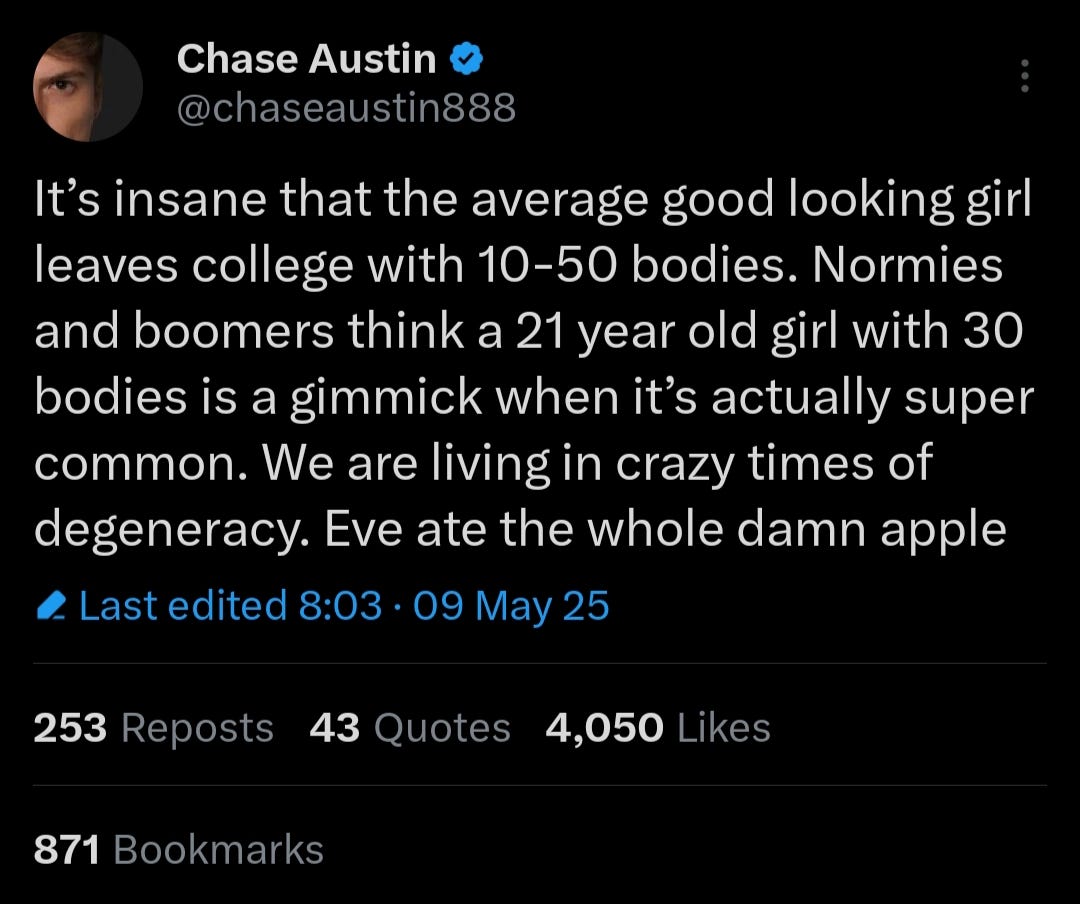
The kind of conspiratorial post exemplified below taps into insecurities and FOMO and stokes resentment by painting a picture whereby women are all hyper-promiscuous 304s indulging in wild orgies 24/7—yet you still can’t get laid! On the flipside, it could also appeal to a more hopeful desire: maybe if I looksmax enough or master the right PUA strategy I can join in on the fun too.
‘Hook-up apps’
There is also a widespread belief that dating apps are actually hook-up apps that have made sexual relations more casual and superficial at the expense of long-term commitment. This idea is associated with the Chadopoly narrative, but also exists independently of it, with articles featuring women lamenting ‘hook-up culture’ in the ‘age of Tinder’. As I’ve covered previously however, there is very little evidence supporting this notion. Dating apps lead to very few sexual encounters among heterosexuals, and relationships are at least as likely to result from a match as is a one-night stand. Even if dating app users tend to have more sexual partners than non-users, there’s little evidence that dating apps themselves are causally responsible.
It could be the case however that seeing provocatively dressed or posed women on dating apps is another thing skewing perception, especially if they’re algorithmically advantaged.
Empowering
Again, sex-positive feminists will often argue that women have as much sexual desire as men and that sleeping around is liberating and a way of asserting sexual autonomy. It might also be the case that wearing more revealing and ‘empowered’ outfits adds to perceptions of widespread promiscuity even if this isn’t as much of an accurate signal of promiscuous inclinations as it might have been in the past.
Lib signalling
Liberals claiming monogamy is outdated, promoting polyamory and open relationships, and celebrating queer sexual practices through parades featuring leather fetish and kinkwear likely contributes to the general air of degeneracy perceived by many in modern society.
Tradcons
In some cases, tradcons or religious conservatives might exaggerate promiscuity to stress the necessity of traditional marriage norms. When combined with the Chadopoly narrative, this becomes especially alarmist, with calls for enforced monogamy to prevent a mass incel uprising.
Tradcon women may also talk about the out of control promiscuity of modern women in what some would call a pickme fashion—distancing themselves from degeneracy and emphasising their own purity.
Cope
Indirectly, the promiscuity narrative serves as a cope, enabling the meme of de facto polygyny via soft harems. It’s more comforting to imagine yourself an incel in a winner-takes-all sexual marketplace than in a less imbalanced monogamous system.
Projection
Many men assume that if sex is so consequence-free for women now, they must be having as much of it as they themselves desire, because it’s so ‘easy’. This is an especially common thought process in incel communities which have high rates of autism, leading to theory of mind deficits.
It’s a ‘hard truth’
This fits into a broader array of claims masquerading as ‘red pills’ or ‘hard truths’ that normies don’t want to talk about. This veneer of brutal honesty appeals to those psychologically primed to view cynical or ‘controversial’ claims as more legitimate.
Pornbrain
With an endless sea of porn just one click away, a much larger share of the women a lot of men see nowadays are being deepthroated or doing something depraved. It’s hard to imagine this not having a perception-warping effect.
Conclusion
The term ‘hook-up culture’ has been bandied around for a while, but there’s little indication it reflects the normative sexual script a broad term like ‘culture’ implies. As they say, repeat something often enough and it becomes the truth.
The so-called sexual revolution and advent of birth control may have led to a modest rise in premarital and casual sex, and perhaps unshackled the small minority of nympho women who were previously restrained, but for the bulk of men and women, the shift towards more permissive sexual attitudes hasn’t been accompanied by an equivalent shift in behaviour. Attitudes and behaviour are often misaligned: a 1962 study found that more Danish adolescents approved of premarital sex than had engaged in it, whereas in the US, the reverse was true.
Even historically though, premarital sex likely wasn’t as rare as often assumed. In the US, 61% of men born prior to 1910 admitted to it, and over 80% of women born in the 1940s had premarital sex—though of course unlike today, many of these encounters would’ve led to shotgun marriages.
Most sex occurring within relationships also aligns with both college-aged men and women’s (though more women’s) reported preferences for traditional romantic relationships, and many men and women (again, slightly more women) also report hoping their hookup encounters lead to them.
To summarise:
Heterosexual promiscuity remains relatively uncommon, and is, if anything, on the decline—consistent with broader trends.
Women are generally unreceptive to sexual offers, even from attractive men.
Low orgasm rates during hook-ups help explain women’s general disinterest and dissatisfaction with them.
Women with higher body counts and permissive values tend to pair with men who also have these. Much of the sexual activity among the most promiscuous occurs within this subset.
Highly sexualised media and algorithms that overrepresent a relatively small population among other factors contribute to a distorted view of the average.
The narrative of rampant promiscuity combined with the hypersexualisation of media and the internet could explain much of the frustration and resentment we see among men who are being increasingly reminded of sexual abundance they lack access to.
Within-gender inequality in sexual encounters is essentially identical for men and women, and STD data shows no evidence of a large or widening gender gap. Moreover, data on actual outcomes dates and sexual encounters through dating apps reveals no gender imbalance (on the population level).
I guess these figures are plausible if you account for homosexual encounters, undersampling of escorts, and younger partners.
While it appears at first glance that the acceptance rates have since fallen, I ran some significance tests and didn’t find significant differences in acceptance rates between singles here and in the Dutch and German studies. So while the authors state that their findings show ‘acceptance rates of both men and women were much lower than those reported by Clark and Hatfield and also lower than those of previous replications’, I’d be more hesitant to draw firm conclusions. These European studies do seem to show lower acceptance rates for date requests overall than the original Clark & Hatfield study, though unfortunately that study didn’t assess the relationship status of subjects.
h/t bored observer.
It’s interesting that despite this, male promiscuity isn’t strongly connected to attractiveness. Maybe it would be higher for being a high sociosexuality woman’s sex partner, as factors unrelated to being sought after by willing women (e.g. ‘mating effort’) may suppress the correlation between attractiveness and promiscuity among men.
Have you considered the women may be underreporting the number of partners they sleep with, sexual experiences, etc. I've now read several of your posts, and none of them fit with most people's lived experience. Where are you addressing the different between reported experiences and revealed preferences. Like, for example, you state in another post that dating apps work about as well for men as for women--no one who is using them thinks that. Not even women.
Would love to be proven wrong, but if it's with data from voluntary self reported surveys, it's just not convincing, because people lie! And women are especially likely to lie about sex and the number of sexual partners they have for obvious reasons.
Wow how nuanced I can feel the truth seeping deep into my bones reading this. 90% of the “data” here was collected from surveys, which is obviously going to have many liars, especially from women who basically evolved to lie about everything. I very much so doubt they were able to mean out all of the liars as they would still be predicting and estimating based on the sample size— which already creates a new problem. And I’m supposed to believe that a Chad was truly only accepted by 1%? Yes I do believe that if he just walked up to them for 30 secs and asked, but if he was able to talk to them for about 15 Mins (which is much longer than a day) I would reckon it’s higher, although this of course is speculative! Also claiming the man is attractive means nothing if you don’t go into how attractive they were, saying top 10% doesn’t mean anything again as you are not telling us how and where they got that number— another survey? Is that where, or was it simply someone they deemed attractive, did college women who decided to be about of the study choose who was actually attractive, or was it more baseless inferences from small groups. Top 10% lmao, maybe I missed the where you said it, but jeez! (I forgot most of it after reading it, but if it answered some of my questions already let me know)