No, this study didn't show Tinder led to Chad harems or mass promiscuity
The findings are being presented in a misleading manner.

A paper that has been in the works for a while – an earlier version of which I briefly covered in the dating apps article – has now been published by Büyükeren et al. (2026).
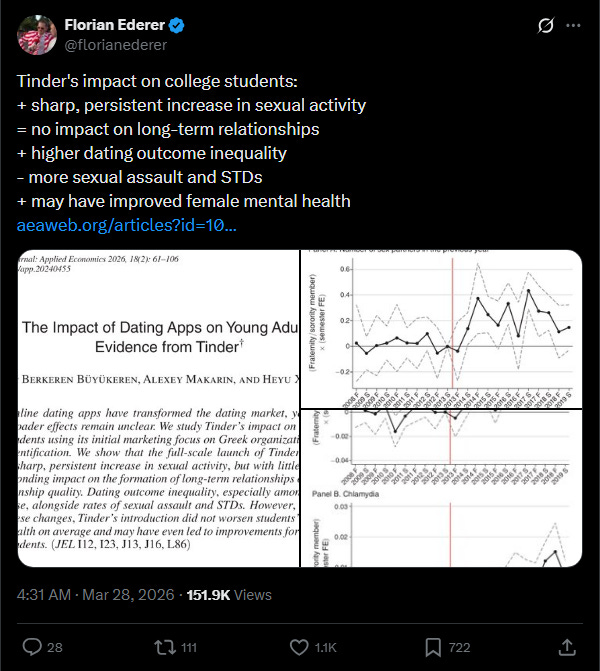
One post, largely a copy-paste of one from a year earlier, claims that among ‘college students’ there has been:
A sharp, persistent increase in sexual activity.
Higher dating outcome inequality.
More sexual assault and STDs.
Another summarizes the findings as follows:
Tinder led to a sharp and persistent increase in sexual behavior among college students, but had no effect on long-term relationship formation or quality. The app also led to an increase in dating inequality (especially among men), a rise in sexually transmitted infections, and an uptick in sexual assault.
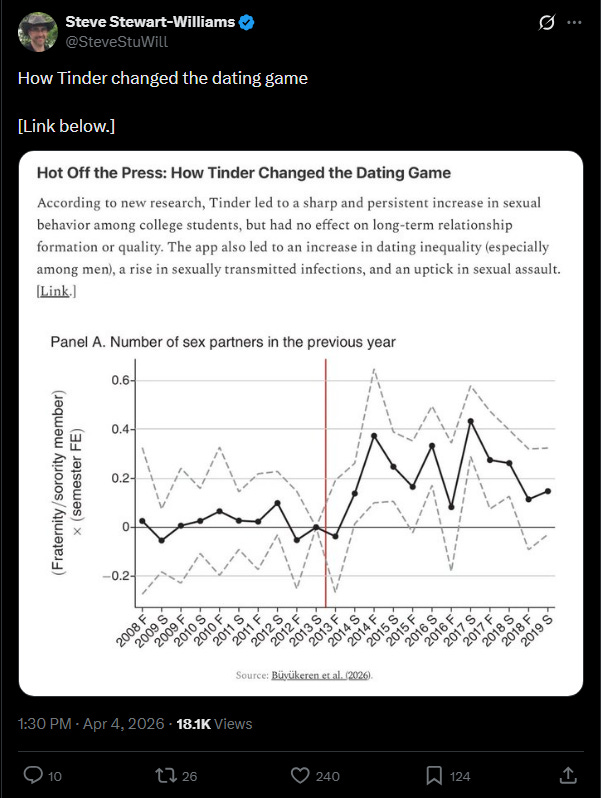
Now, I’m not saying this is being pulled from nowhere – the paper’s abstract itself states: ‘We show that the full-scale launch of Tinder led to a sharp, persistent increase in sexual activity’, and that ‘dating outcome inequality, especially among men, rose’.
Still, I take issue with this framing. Let’s get into why.
Tinder has not led to mass promiscuity
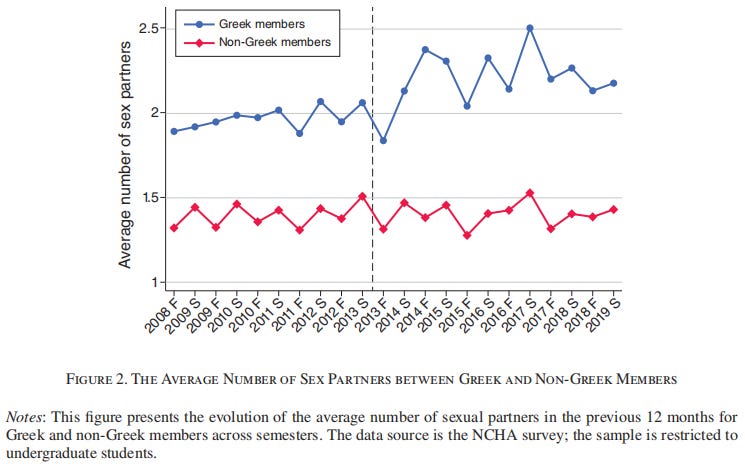
As for the first claim, the issue is twofold. Firstly, while this has been reported as an increase among ‘college students’ in a broad sense, the effect was actually unique to Greek students.1 Even six years following the launch of Tinder, the rest of the student body remains seemingly unaffected, with their average annual number of sex partners hovering below 1.5.
Secondly, the magnitude of the effect wasn’t exactly impressive. The gap in average annual sex partners between Greek and non-Greek students increased by 0.22, and Greek students became 3.1 percentage points more likely to have had sex in the past year. These effects correspond to increases of 0.07–0.08 standard deviations. Since Greek students constitute 10% of the student body, the average increase across all college students was just 0.02, with a standard deviation change below 0.01.
Now, ‘sharp’ is obviously subjective… but to what extent? I’d argue most people would expect at least a 0.5 SD increase to merit that label. You could contend that magnitude isn’t the only consideration. Maybe the speed of the change justifies it. It was notably higher than previous years in the fall of 2014, which is reasonably soon after the launch, but regardless, sharp would typically indicate a combination of magnitude and speed – otherwise it’s just a ‘sudden’ increase.
As for STDs, there was a significant rise in chlamydia incidence among Greek students by 0.6 percentage points and an increase in HIV tests of 1.6 points, equivalent to 0.05 and 0.04 SDs, respectively.2
Since this analysis drew on an enormous dataset, even practically negligible effects can emerge as highly statistically significant. As I’ve noted in previous articles, this kind of reporting is misleading due to a bias that (not to turn this into a hit piece) one of those covering this study has themselves discussed:
When media coverage of scientific findings fails to mention the size of the effects reported, people tend to assume that the effects are large - large enough to have practical significance.
No evidence that Tinder has led to Chad harems
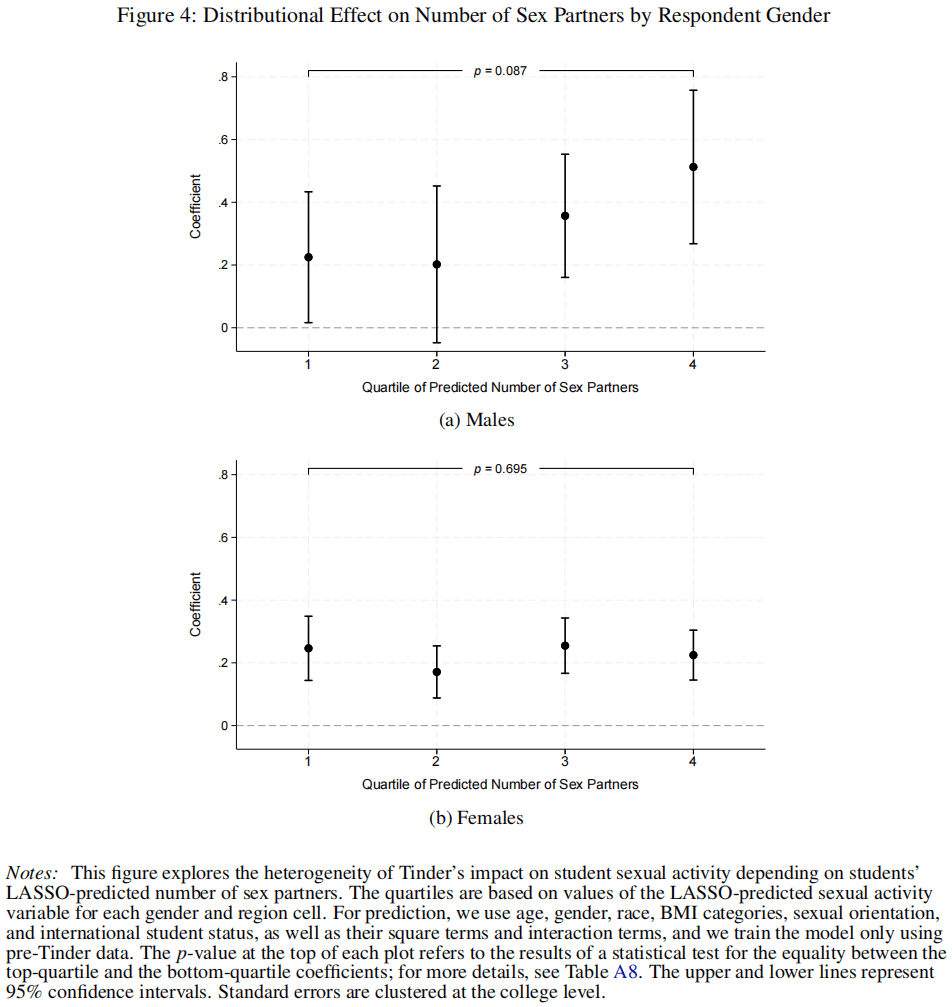
For the second claim, the issue is a bit more complex. Earlier versions of this paper included an analysis on the heterogeneity of Tinder’s impact. Students were split into four quartiles according to their predicted number of partners, calculated using age, gender, race, BMI, sexual orientation, and international student status, with the model trained on pre-Tinder data.
The results were reported as: ‘Inequality in dating outcomes increased among male students but not among female students’. More specifically:
The total effects for each quartile are displayed in Figure 4. While the estimates are positive for both genders for all quartiles, we observe a significant jump in effect size for male students belonging to the top quartile of predicted sex activity. These patterns are confirmed in Table A8, which show that, for male students, the difference in effect on the number of sex partners between the upper and lower quartiles of LASSO-predicted sexual activity is statistically significant. For female students, on the other hand, there is no discernible difference across quartiles.
These contrasting patterns of heterogeneity suggest that the distributional impact of Tinder may differ across gender groups and, in particular, that Tinder may facilitate the emergence of “superstar” effects for males in the dating market. These results are consistent with existing evidence that female dating app users tend to be more selective in their likes and interactions.
The first thing to note is that the effect wasn’t statistically significant under the conventional threshold. Here, the threshold was conveniently set at p < 0.1, despite an enormous number of observations, which if anything would warrant lowering rather than raising the threshold.
Second, the conventional narrative is that Chad is depriving others by ‘stealing’ women, but even the bottom quartile in predicted partners ‘benefitted’, and to a degree similar to women. This is certainly not what most would imagine after hearing that ‘inequality in dating outcomes increased, especially for men’. This is therefore very weak evidence for anything, let alone the conventional neohypergamy narrative.
More recent versions scrapped this analysis entirely – perhaps deciding it wasn’t compelling enough. It was replaced with this new analysis:
In Table 3, we test this idea by examining whether Tinder’s full-scale launch led to an outward shift of the entire distribution of sexual activity among Greek students relative to non-Greek students. Specifically, Table 3 presents a version of our baseline estimates from Table 2, but now using indicators for whether a student had more than a certain number of sexual partners in the past 12 months (ranging from strictly over zero to strictly over eight; see Supplemental Appendix Table B1 for additional estimates for indicators strictly over nine and ten partners) as outcomes. Across all such indicators, we consistently obtain positive coefficients, which also tend to grow as a proportion of the dependent variable mean as we move toward the right tail of the distribution. Supplemental Appendix Table A8 breaks these results down by gender and shows that the effects are larger in absolute terms for male students.
It seems like what we observe here is mostly a slight shift in the sex partner distributions to the right. The patterns are similar for both sexes: the coefficient peaks at >2 partners, and the coefficients decline as the threshold increased at a similar rate from there. There may have been larger proportional increases at the tail, but in absolute terms the change is minimal, and the largest absolute changes are near the middle, consistent with a small overall shift in the distribution.
The differences in changes at high partner counts don’t appear likely to be significant. For example, the coefficient for men and women for >10 partners are 0.005 and 0.003, respectively, meaning fraternity members became 0.5 percentage points and sorority members 0.3 percentage points more likely to report over 10 partners relative to non-Greek students. The standard error for >10 partners for men is 0.002, giving a 95% confidence interval of roughly 0.001–0.009, which overlaps substantially with the female coefficient. This holds true for the other coefficients as well, with some exceptions.
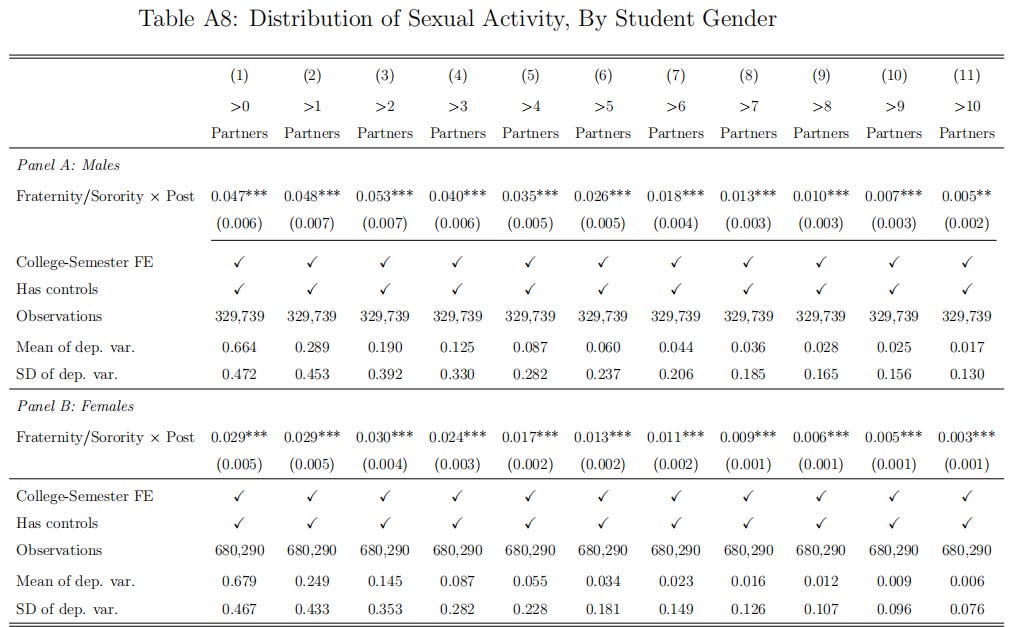
If the Chad story were true, we might expect a larger rise in women with moderate partner counts than in men, but a smaller rise among those with high partner counts. Instead, all of the coefficients were slightly higher for men.
Partners don’t seem to be opposite-sex specifically, so any apparent sex differences could possibly be driven more by Grindr than Tinder. Fraternities are typically perceived as ‘heteronormative’ environments, but how true this is in terms of sexual behaviour I don’t know.
Tinder has not destroyed relationships
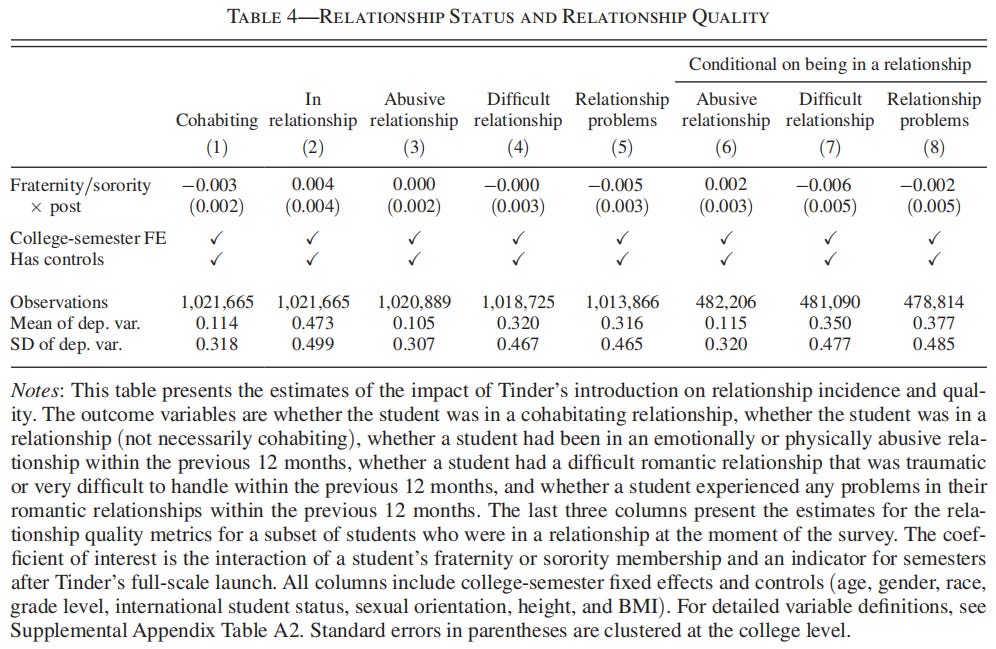
One popular narrative around dating apps is that they’ve disrupted relationship formation in favour of ‘hook-up culture’ and ‘situationships’. However, the small increase in sex partners among the limited Greek subset of the student population doesn’t appear to have come at the expense of relationships or relationship quality.
Conclusion
Despite claims of a ‘sharp increase’, which reports presented as affecting ‘college students’ in general, the study found only a very small increase in sex partners and STDs among Greek students, who constitute 10% of the college population. From what I could tell, the authors failed to provide convincing evidence of a significant increase in sexual inequality beyond the disparity between Greek and non-Greek students, despite implying it.
I recognize that some view this kind of critique as too ‘nitpicky’, but I’m unconcerned with such charges. Factual precision and clear, honest reporting are important. Accusations like ‘pedantic’ and ‘deboonker’ are often just weak attempts to shut down legitimate criticism.
Another caveat is that there is no direct evidence linking these changes to Tinder, though the timing and launch strategy targeting Greek students make a connection plausible.
The evidence against dating apps facilitating widespread neohypergamy is quite overwhelming:
The most promiscuous 20% of men and women account for a similar share of their sex’s total sexual encounters, a pattern that has remained unchanged since Tinder’s introduction.
STD rates among heterosexual men and women have moved in tandem.
Sexlessness rates have moved in tandem.
The singleness sex gap among young adults is not widening and can be reasonably explained by relational age gaps.
Physical attractiveness and height have similarly weak correlations with sex partner count as they did previously.
Dating app within-sex desirability effects, match number skew, and actual outcomes show no sex imbalance.
Promiscuity is not on the rise.
This study does little to alter this picture.
I would be surprised not to see a lot more of this paper going forward, usually cited without any specificity or quantification, just ‘this study showed Tinder increased promiscuity and sexual inequality’. LLMs will likely be citing the hell out of it. All people need is a statement from a ‘peer-reviewed’ article; the evidence is secondary. The gaps get filled with the dramatic version people expect or want to see. Few will be inclined to look deeper, as doing so risks deflating their imagined narrative. This has happened before, and it will happen again.
I’m going to go out on a limb and say that I would be surprised if the researchers didn’t go into the study with the expectation of finding the Chad effect. Such a priori assumptions most likely lead researchers, consciously or unconsciously, to draw it out of data and overinterpret it. If I were to put on my cynic hat, I’d say they’re aware it’s a popular narrative (a cited article confirms this) and that putting a line about it in the abstract, however weakly supported, would give it a boost.
This serves as a reminder not to take what you hear about a study at face value, whoever is saying it. There is every incentive for researchers, media outlets, and communicators to spruce up the findings or otherwise leave them ambiguous. The study isn’t without any value, but compared to the hype, it’s mostly a nothingburger.
Not students in Greece, but members of fraternities and sororities.
A footnote notes that coefficients were ‘slightly larger for female students’, but the difference for chlamydia was basically nothing (0.001).
Thanks for this article. You answered all the questions I had in my head in the next paragraph as I was reading. "Yeah, but what are the effects sizes?" "Are these practically significant?" Etc.
You are exactly right this is the kind of non-results we get from publish-or-perish "we need to find something" culture when there is little to nothing there.
And unfortunately the "it's peer reviewed" masses (and now LLMs) who didn't actually read the article will cite the hell out of it.
My friend why are you being delusional do you not look at claviculars streams just cause you see normies women with men doesn't men she desires him most of these women are secretly desiring some 1 better